scenes from the chalivali
for loadbang
In Seven Movements:
Lauda I || Interstice I || Motet I || Motet II || Interstice II || Motet III || Lauda II
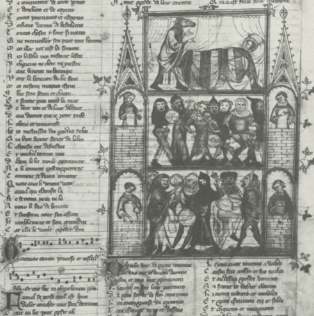
Scenes from the Chalivali is a contemporary reading of the Chalivali (Shivaree) scene in the Roman de Fauvel, a 14th century allegorical political satire. The story is told through the pages of a highly theatrical and musical illuminated manuscript. A shivaree (spelled chalivali in the Roman de Fauvel) is a celebratory and clangorous European wedding tradition which involves shouting and banging on pots and pans while newlyweds enter their bedroom for the first time. The tradition, however, has its roots in a different community practice from the Middle Ages. In the shivaree of the Middle Ages, a group of young men would chastise individuals who did not uphold community values, often pertaining to moral and sexual norms. The Roman de Fauvel, among many of its other subversive elements, turns this ritual on its head — community members and creatures institute a political protest through the guise of a shivaree. The Fauvel verset text from the shivaree scene is a deliberate bastardization of a verse in Deuteronomy 32:20-21, making ambiguous through grammatical trickery the subject of the ritual’s reproach. My text for this piece extends the Fauvel chant with two words, ab inferis (by the people of hell), definitively opting for an alternative and subversive interpretation. The two texts (from Deuteronomy and the Fauvel), and translations, are as follows:
generatio enim perversa est et infideles filii (for it is a perverse generation, and unfaithful children)
ipsi me provocaverunt in eo qui non erat Deus (They have provoked me with that which was no god)*
generacio eorum perversa et infideles filii (they are a perverse generation and unfaithful children)
et erit hoc in obprobrium ipsis** ab inferis*** (and this will be a reproach to them by the people of hell)
This piece is devised as a re-enacting of this interpretation of the text through generative processing of the Roman de Fauvel‘s original musical material, inviting a queer reading of moral reproach and perpetual generational tension.
*Deuteronomy 32:20-21
**from Roman de Fauvel
***added by the composer
 Seare Ahmad Farhat